Pearl Harbor
  1. Home
  2. USS Oklahoma Memorial

429 names, 429 individual lives

USS Oklahoma Memorial visitor guide

Stand among 429 white marble standards honoring the sailors and Marines lost when USS Oklahoma capsized at Pearl Harbor, and understand the reservation required to reach this active-base memorial.

Independent visitor guidance. Always confirm current conditions with the official operator before travel.

Lives honored429Sailors and Marines lost aboard
LocationFord IslandInside an active military base
Public accessReserved NPS tourFor visitors without qualifying base ID
DedicatedDecember 7, 2007Sixty-six years after the attack

A memorial built around individuals

Why the USS Oklahoma Memorial deserves more than a passing stop

The USS Oklahoma Memorial is one of Pearl Harbor’s most affecting spaces, yet it is often overshadowed by the USS Arizona Memorial and the neighboring Battleship Missouri. Its design makes the scale of loss immediately human. Four hundred twenty-nine white marble standards rise from a field framed by dark granite. Each standard carries the name of one sailor or Marine who died aboard Oklahoma on December 7, 1941.

Those upright forms evoke a crew in dress whites “manning the rails,” a naval gesture of honor. The black granite suggests the battleship’s hull. Visitors can walk among the standards rather than viewing a single distant monument, so 429 is no longer only a statistic. The repeated names, ranks and spaces ask the visitor to consider each person as an individual with a family, a role aboard ship and a life interrupted.

Reaching the memorial requires deliberate planning. It stands on Ford Island, which remains an active U.S. military base. The National Park Service currently instructs visitors without an Active-Duty Military ID to reserve the ranger-facilitated Ford Island Bus Tour through Recreation.gov. That program visits both the USS Oklahoma and USS Utah memorials. A normal drive to the visitor center, a USS Arizona reservation, a ticket for Battleship Missouri or a commercial Pearl Harbor tour should not be assumed to include this NPS access.

This guide separates the memorial’s history from the practical route. First understand what happened to Oklahoma and what its design communicates. Then treat the Ford Island program as a timed, security-controlled experience with its own reservation, identification, baggage, walking and accessibility requirements.
Before you reserve

Four facts that prevent the most common planning mistakes

The Oklahoma Memorial is physically close to Battleship Missouri, but its current public-access instructions come from the National Park Service.

Use the official Ford Island program

Visitors without an Active-Duty Military ID should reserve the NPS-facilitated Ford Island Bus Tour. The escorted program visits both Oklahoma and Utah and begins at the Pearl Harbor Visitor Center.

Every participant needs a ticket

The official instructions require a reservation for each person, including infants and small children. Reservations are non-transferable, and the purchaser must bring a government-issued photo ID.

Treat timing as fixed

The program operates on selected days and requires early check-in. Official descriptions currently differ slightly on duration and departure wording, so use the exact time shown on your confirmation.

The tour is for independent travelers

Recreation.gov states that the program is for free-and-independent travelers and does not admit commercial tour groups. An affiliate tour booking does not automatically provide Oklahoma access.

The ship and the attack

From battleship to a capsized hull in roughly twenty minutes

Oklahoma’s story is not only about the number of torpedoes. It is about the speed of the disaster, rescue attempts, salvage and a loss that remained unresolved for many families.

MomentWhat happenedWhy it matters at the memorial
Before December 7USS Oklahoma (BB-37), a Nevada-class battleship commissioned in 1916, was moored along Battleship Row beside USS Maryland.The memorial’s dark stone recalls a major warship and gives physical context to the white standards representing the crew.
Opening attackJapanese torpedo aircraft struck the exposed port side. The National Park Service describes seven to nine torpedo hits.Repeated impacts caused rapid flooding before many sailors could reach open deck or organize an escape.
CapsizingOklahoma rolled over in roughly twenty minutes. More than 400 men were trapped inside the overturned hull.The sudden inversion explains why ordinary escape routes became deadly and why sounds from within the hull drove urgent rescue work.
RescueCrews cut through the exposed hull and rescued 32 trapped men, while many other survivors had escaped during the roll.The story contains extraordinary survival and rescue, but the memorial remains centered on the 429 who died.
SalvageThe ship was righted through a major engineering effort, but it did not return to service. It was decommissioned in 1944.Unlike Arizona and Utah, Oklahoma’s hull is not present at the memorial. The architecture must carry the ship’s absence.
Final loss of the hullSold for scrap after the war, the former battleship sank in 1947 while being towed from Hawaiʻi toward the mainland.The memorial therefore marks memory and former mooring landscape rather than a visible wreck.

Avoid reducing the story to “second-highest loss”

Oklahoma suffered 429 deaths, the second-largest loss of life on a ship during the attack. The memorial’s purpose is to restore individuality to those 429 people, not to turn one ship’s tragedy into a ranking.

How to read the site

The missing hull is expressed through stone, alignment and space

The memorial was dedicated on December 7, 2007, sixty-six years after the attack. Its contrast is deliberate: dark granite conveys the mass and form of the battleship, while 429 pale standards stand upright as if the lost crew were assembled in dress whites. The naval tradition of manning the rails transforms an act of ceremony into an image of return.

Walk slowly enough to notice that each standard is named. A wide photograph can communicate scale, but the memorial is best understood at walking pace. Read several names and ranks. Look at how repetition creates unity without erasing difference. The standards do not represent anonymous units; each one holds a particular identity.

429 white standards
One for every sailor and Marine who died aboard Oklahoma during the attack.
Dark granite
A visual reference to the battleship’s powerful hull and to the ship that is no longer present at Pearl Harbor.
Manning the rails
The aligned forms recall sailors standing in dress whites along a ship’s edge during a formal naval honor.
A walk-through memorial
Visitors move among the names, changing the experience from a distant view to a personal encounter.

The neighboring Missouri can create a powerful historical bookend, since it represents the formal end of World War II. Do not let that interpretive contrast rush the Oklahoma visit. One site presents a preserved battleship filled with spaces and objects; the other uses absence and names to ask for reflection.

Practical decisions

Plan the escorted Ford Island visit correctly

Security control, a small reservation inventory and a fixed group route make preparation more important here than at an ordinary museum.

Watch the booking window

Recreation.gov currently says 25 tickets are released 14 days before each tour at 3:00 p.m. Hawaiʻi Standard Time. Inventory and release rules can change, so check the live listing.

Bring the purchaser’s ID

A valid government-issued photo ID is required at check-in. The reservation is non-transferable, so the named purchaser should be present.

Protect the full time block

Allow roughly 75 to 90 minutes plus early check-in. Do not schedule a late USS Arizona program or a time-sensitive transfer against this window.

Prepare for uneven ground

The official listing warns of up to 45 minutes of walking and standing on uneven ground. Wear stable footwear and account for heat and rain.

Arrive without ordinary bags

The tour listing states that bags are not allowed. Review the current Pearl Harbor security policy and use paid storage before check-in if necessary.

Request access help early

Contact the park as soon as possible if an accessible bus or other assistance is needed. Do not assume every scheduled coach has the same setup.

A respectful visit

Give the memorial the attention its design requests

The experience is short enough to be easily rushed. These choices make it more meaningful without adding unnecessary ceremony.

Stay with the ranger-led group

Ford Island is an active base. Follow the prescribed route, time limits and all instructions without separating from the group.

Photograph with restraint

Photography of private residences is prohibited. At the memorial, prioritize names and context over staged poses.

Read before arriving

A basic understanding of the capsizing and salvage makes the abstract architecture easier to interpret during a limited stop.

Leave schedule margin

Base-security conditions can cancel the program at short notice. Avoid a day that depends on the tour ending at an exact minute.

Continue planning

Turn this information into a complete visit

These guides connect the practical decision on this page with the sites and experiences you may want to add.

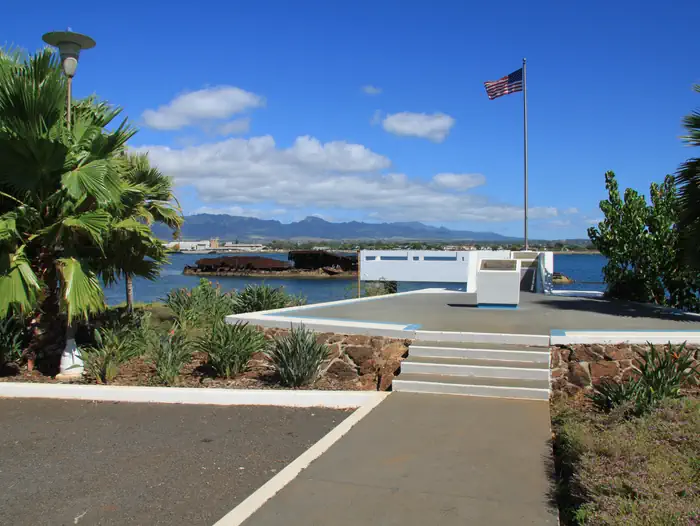
USS Utah Memorial beside the visible wreck off Ford Island

Included on the same NPS route

USS Utah Memorial

Continue to the less-visited memorial where the visible hull remains in the water and 58 lost crew members are remembered.

Understand the USS Utah Memorial
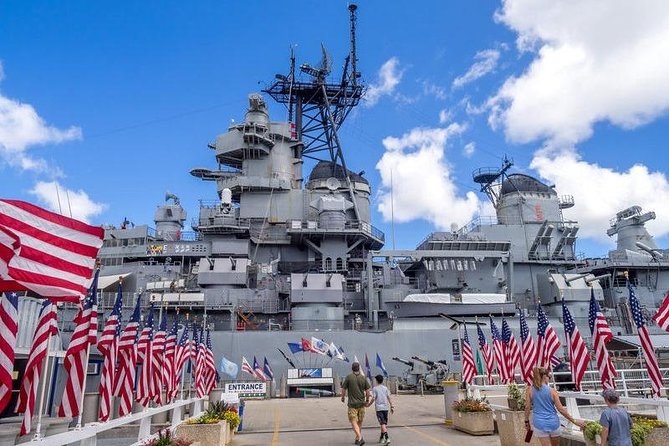
Battleship Missouri moored on Ford Island near the USS Oklahoma Memorial

Nearby historic ship

Battleship Missouri

Explore the preserved battleship associated with the formal end of World War II, but plan its admission and shuttle separately.

Plan Battleship Missouri
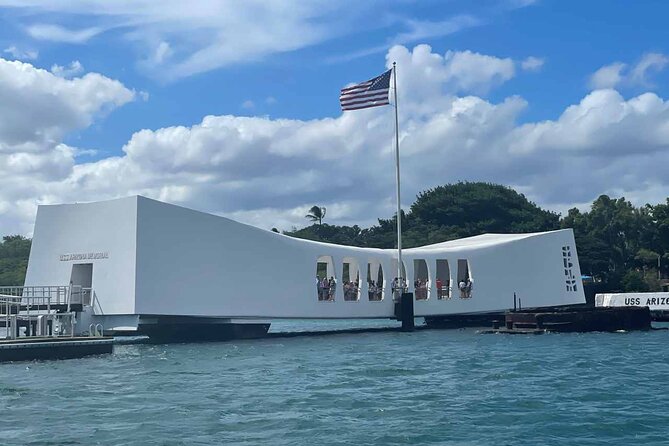
USS Arizona Memorial above the sunken battleship in Pearl Harbor

Separate reservation

USS Arizona Memorial

Reserve the Navy boat program independently and avoid late-afternoon times that conflict with the Ford Island memorial tour.

Plan the USS Arizona program

Independent visit or organized tour

Commercial tours do not include the NPS Ford Island memorial program

A hotel-pickup Pearl Harbor tour can simplify transportation to the visitor center and may include the main museums, but Recreation.gov states that commercial tour groups cannot participate in the NPS Ford Island Bus Tour. If Oklahoma is a priority, reserve the government program as an independent traveler and build the rest of the day around it.

Do not rely on tour marketing that says “Ford Island” or “Battleship Missouri” as proof that the Oklahoma Memorial stop is included. Ask for the exact named sites, and remember that USS Utah requires the escorted NPS route for general public access.

Affiliate disclosure: PearlHarbor.info may earn a commission from eligible bookings, at no extra cost to you. Verify every tour’s current schedule, admissions and accessibility before booking.

Named inclusionsLook for the exact memorial name, not broad phrases such as “all Pearl Harbor highlights.”
Schedule compatibilityConfirm that any morning commercial tour ends with enough time to check in independently at the visitor center.
Return transportIf the commercial tour leaves before the NPS program ends, arrange your own transportation from Pearl Harbor.

Frequently asked questions

Visiting the USS Oklahoma Memorial

Can the public visit the USS Oklahoma Memorial?

Yes. Current NPS guidance says visitors without an Active-Duty Military ID must reserve the ranger-facilitated Ford Island Bus Tour through Recreation.gov. The escorted program visits both the Oklahoma and Utah memorials.

Is the USS Oklahoma Memorial included with a Battleship Missouri ticket?

Do not assume it is. Although the memorial is physically near Missouri, the current NPS public-access instruction directs visitors without qualifying military ID to the reserved Ford Island Bus Tour. Treat Missouri admission and the NPS program as separate.

How long is the Ford Island Bus Tour?

Official descriptions currently vary: the NPS overview describes a 75-minute round trip, while Recreation.gov describes a 90-minute program and up to 45 minutes of walking or standing. Follow the exact check-in and program time on your reservation.

How much does the USS Oklahoma Memorial cost?

The memorial and NPS program are fee-free, but Recreation.gov currently charges a $1 non-refundable reservation fee per person. Parking at the visitor center is currently $7 per day for private or rented vehicles.

How many people died aboard USS Oklahoma?

Four hundred twenty-nine sailors and Marines died when Oklahoma capsized during the attack. The memorial represents each of them with an individually named white marble standard.

Does the Ford Island tour include the USS Arizona Memorial?

No. The USS Arizona Memorial boat program requires its own reservation or standby process. Current NPS guidance also warns that some late Arizona program times conflict with the Ford Island tour.

Is the USS Oklahoma Memorial accessible?

The bus tour includes walking and standing on uneven ground. Recreation.gov asks visitors who need wheelchair or accessible-bus assistance to contact the park as soon as possible before the visit.

Historical and operational information reviewed July 28, 2026 against the National Park Service, Recreation.gov and U.S. Naval History and Heritage Command. The NPS and Recreation.gov currently describe the Ford Island program with slightly different durations; use the schedule printed on the live reservation.